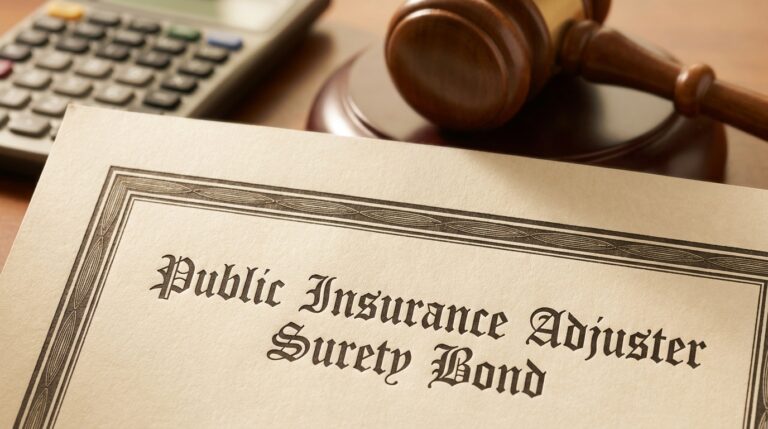
Before negotiating a property claim, handling a settlement check, or advocating for a policyholder against a corporate insurance carrier, you must overcome a significant regulatory hurdle. You must prove to your state’s Department of Insurance that you are financially accountable. You achieve this by securing a public adjuster surety bond.
When entering the lucrative world of insurance claims, many new professionals get confused by the financial prerequisites. You already pay for pre-licensing education, state exam fees, and fingerprinting background checks. Why is the state demanding a financial bond as well?
To navigate the licensing process efficiently, you must understand exactly how these financial instruments work, what they actually cost, and the fastest way to secure one. Here is the definitive guide on the costs and requirements of securing surety bonds for claims adjusters.
What is a Public Adjuster Surety Bond? (And Who It Actually Protects)
The most dangerous misconception in the claims industry is the belief that an adjuster bond functions like an active insurance policy for your business. It absolutely does not. If you make a mistake scoping a roof or miscalculate a depreciation schedule, this bond will not pay for your legal defense.
A public adjuster surety bond is a three-party legal contract engineered strictly to protect the public, not the professional. The three parties involved are:
-
The Principal: You (the public adjuster applying for the license).
-
The Obligee: The state Department of Insurance (the entity demanding the bond to protect its citizens).
-
The Surety: The financial institution underwriting the bond and guaranteeing your professional conduct.
When a state issues your license, they grant you immense financial power. You frequently access hundreds of thousands of dollars in settlement funds. If a bad-faith adjuster embezzles a payout, commits deliberate fraud, or engages in unfair business practices, the state can revoke their license. However, revoking a license does not recover the victim’s money.
This is where the bond triggers. The wronged policyholder can file a claim against your public adjuster surety bond. If validated, the surety company immediately compensates the victim up to the total penal sum of the bond. Unlike traditional liability insurance, you are legally obligated to repay the surety company for every single dollar they paid out on your behalf, plus legal fees.
State-by-State Breakdown: How Much Coverage Do You Need?
Because public adjusting is regulated at the state level, there is no universal standard for bond requirements. Your geographical location dictates your exact financial barrier to entry.
Some states require a relatively low threshold. To secure a license in Texas, you only need to post a $10,000 surety bond. New York and Ohio require a mere $1,000 bond.
However, in states that frequently suffer from catastrophic weather events and high volumes of complex property claims, regulatory agencies demand maximum financial protection. If you operate in Florida, Louisiana, or Tennessee, you are legally required to carry a $50,000 public adjuster bond. States are also actively tightening these regulations. In response to rising catastrophic weather claims, Iowa recently increased its mandatory bond limit from $20,000 to $50,000 for all new and renewing applicants.
If you plan to scale your firm and hold non-resident licenses in multiple states, you must purchase and maintain a separate, state-specific surety bond for every jurisdiction where you operate.

How Much is an Adjuster Bond? Breaking Down the Premium
When new candidates see a $50,000 requirement, they frequently panic, assuming they must deposit fifty thousand dollars in cash with the state. Fortunately, the surety industry does not operate that way.
So, how much is an adjuster bond out of pocket? You only pay a small annual premium to keep the bond active.
Your final insurance adjuster bond cost is determined entirely by the underwriting process, which relies on your personal credit score. Because the surety company extends you a line of credit, they verify your financial responsibility before assuming the risk.
-
Tier 1 (Excellent Credit): If your FICO score is above 700 with no bankruptcies, you represent a low risk. You typically pay a premium of 1% of the total bond amount. A $10,000 bond in Texas might cost just $100 a year. A $50,000 bond in Florida costs roughly $500.
-
Tier 2 (Average to Poor Credit): If your credit score is in the 500s or 600s, or you have recent tax liens, you are classified as high-risk. The surety company will issue the bond, but they charge a higher premium, often ranging from 2% to 5% of the bond amount.
-
Flat-Rate Programs: To streamline licensing, modern surety brokerages negotiate flat-rate, instantly approved bond programs for high-volume states. In Florida, you can securely obtain the mandatory $50,000 bond for a flat rate of $350 to $500 per year with zero credit checks required.
The Fast Track: Securing Your Bond Without Delay
The biggest mistake aspiring adjusters make is waiting until the last minute. When a major hurricane hits, Departments of Insurance are flooded with applications. If your application lacks the original, signed surety bond document, the state instantly rejects it, pushing you to the back of a month-long waiting list.
Treat your surety bond as the first step in your licensing package.
Modern commercial brokers have completely digitized the application. You can apply online in less than five minutes. The algorithm runs a soft credit pull and instantly generates a premium quote. Once paid, the brokerage immediately emails a digital copy of the bond.
More importantly, the broker physically mails the original bond document—complete with the mandatory raised corporate seal and the wet signature of the Attorney-in-Fact—directly to your office. You must bundle this original document with your state application, background check receipts, and exam passing certificate to officially activate your license.
Audit your target state’s exact bond requirements, secure your premium quote today, and ensure your licensing application is flawless.
Financial Disclaimer: The information provided in this guide regarding surety bonds, licensing requirements, and insurance regulations is for educational and strategic planning purposes only. It does not constitute formal legal or financial advice. State Departments of Insurance frequently update their bonding thresholds, licensing statutes, and regulatory frameworks. Always verify current bond requirements directly with your state’s insurance commission or a licensed surety broker before submitting applications or paying non-refundable fees.