When a major hurricane enters the Gulf of Mexico, the window for operational preparation instantly slams shut. For a catastrophe (CAT) adjusting firm, the hours immediately following a massive storm are the most critical and lucrative of the entire year. Commercial property owners, condominium associations, and residential homeowners are frantically searching for aggressive representation to manage their catastrophic losses. However, you cannot legally represent them, estimate their damages, or sign a binding contract if your regulatory paperwork is not absolutely flawless.
If you wait until the National Hurricane Center issues a named storm warning to start applying for out-of-state credentials, you have already lost the season. The bureaucratic machinery of state governments does not speed up because you are in a rush. Here is a definitive, strategic guide on how a hurricane season public adjuster must leverage license reciprocity to aggressively expand their geographic footprint before disaster strikes.
Independent vs Public Adjuster: The Regulatory Divide
To understand the urgency of this process, you must first understand the fundamental divide between an independent vs public adjuster.
Independent adjusters are hired by the insurance carriers. Because carriers need thousands of boots on the ground immediately following a catastrophe, many states offer rapid “emergency licenses” for independent adjusters that can be processed in a matter of days.
Public adjusters, however, represent the policyholder. Because you act in a fiduciary capacity—negotiating legal contracts and handling massive settlement funds directly for the consumer—state Departments of Insurance regulate you with a heavy hand. There is rarely such a thing as an “emergency” public adjuster license. You are held to the absolute highest regulatory standard, which means you must secure your permanent, non-resident credentials the traditional way.
The Power of the Reciprocity Public Adjuster License
The secret to scaling a CAT firm across state lines without spending months in classrooms is the reciprocity public adjuster license.
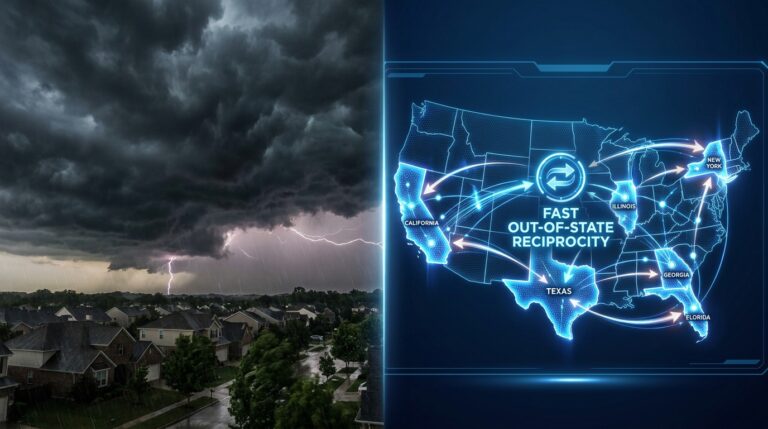
Reciprocity is a mutual agreement between state Departments of Insurance. If you hold a resident public adjuster license in good standing in your home state (such as Texas or Florida), reciprocal states will recognize your expertise and grant you a non-resident public adjuster license without forcing you to sit for their grueling state exam.
For example, if you are a licensed resident adjuster in Texas, and a massive storm is threatening the East Coast, you can apply for a reciprocal non-resident license in Louisiana, Florida, or North Carolina. The reciprocal state waives the pre-licensing education and the state exam because you have already proven your competency in your home state.
Note: If you live in a state that does not license public adjusters, you can designate a reciprocal state (like Texas or Florida) as your “Designated Home State” (DHS) and use that license to trigger reciprocity nationwide.
How to Fast Track Adjuster License Applications
While reciprocity waives the state exam, it does not waive the administrative bureaucracy. Reciprocity is not automatic. You cannot cross state lines with just your home state license; you must formally apply and be approved for the specific non-resident license before you operate.
To fast track adjuster license applications, you must execute the following steps months before the summer storm season begins:
-
Audit Your Home State License: Ensure your resident license is perfectly active. If you are behind on your continuing education (CE) credits, your non-resident applications will be instantly rejected.
-
Utilize the NIPR Portal: Submit your non-resident applications electronically through the National Insurance Producer Registry (NIPR). This centralized portal is the fastest way to route your application to multiple state insurance departments simultaneously.
-
Pay the State Fees: Every state requires a non-refundable application fee. Pay this instantly via the NIPR portal to prevent processing delays.
-
Prepare for Fingerprinting: Some reciprocal states still require you to submit physical or digital fingerprints for a localized background check, even if you already submitted them in your home state.
The Trap: Out-of-State Surety Bonds
The single biggest mistake operations managers make is assuming that reciprocity waives financial requirements. Reciprocity only waives the exam; it never waives the surety bond.
Almost every catastrophe-prone state requires public adjusters to post a state-specific surety bond to protect their citizens from fraud. Your home state bond does not cross state lines. If you are a Texas resident with a $10,000 bond applying for a Florida non-resident license, you must purchase a separate, Florida-specific $50,000 surety bond before the state will approve your application. Likewise, North Carolina requires a strict $20,000 bond for all non-resident public adjusters.
Securing these bonds requires a credit check and underwriting approval from a surety brokerage. If you wait until a storm is making landfall to apply for these bonds, the underwriters will be backlogged, and your license will remain locked in a “pending” status.
The Financial Urgency of Day One Contracting
Why is this intense, preemptive preparation so critical? Because in the catastrophe adjusting industry, the victor is the firm that gets to the client first.
The day after a hurricane decimates a coastal city, commercial business owners are standing in the ruins of their properties, terrified for their financial future. They will sign a contract with the first highly professional, competent public adjuster who arrives on the scene.
If you have your non-resident license and out-of-state surety bond firmly in hand, you can legally hand them a representation contract, secure the client, and immediately begin mitigating their loss. If your license is still pending because you applied too late, it is a felony and the Unauthorized Practice of Law (UPL) to negotiate a claim or sign a contract.
Do not let a bureaucratic delay rob you of your most lucrative season. Audit your target catastrophe states today, process your reciprocal applications through NIPR, secure your out-of-state surety bonds, and ensure your team is ready to deploy the exact second the storm clears.
Operational Disclaimer: The licensing strategies, regulatory timelines, and surety bond requirements discussed in this guide are for B2B educational and operational planning purposes only. They do not constitute formal legal or compliance advice. Department of Insurance regulations, reciprocity agreements, and surety bond minimums change frequently. Always consult the specific state’s Department of Insurance or a licensed compliance coordinator to verify current licensing criteria before executing deployment strategies.